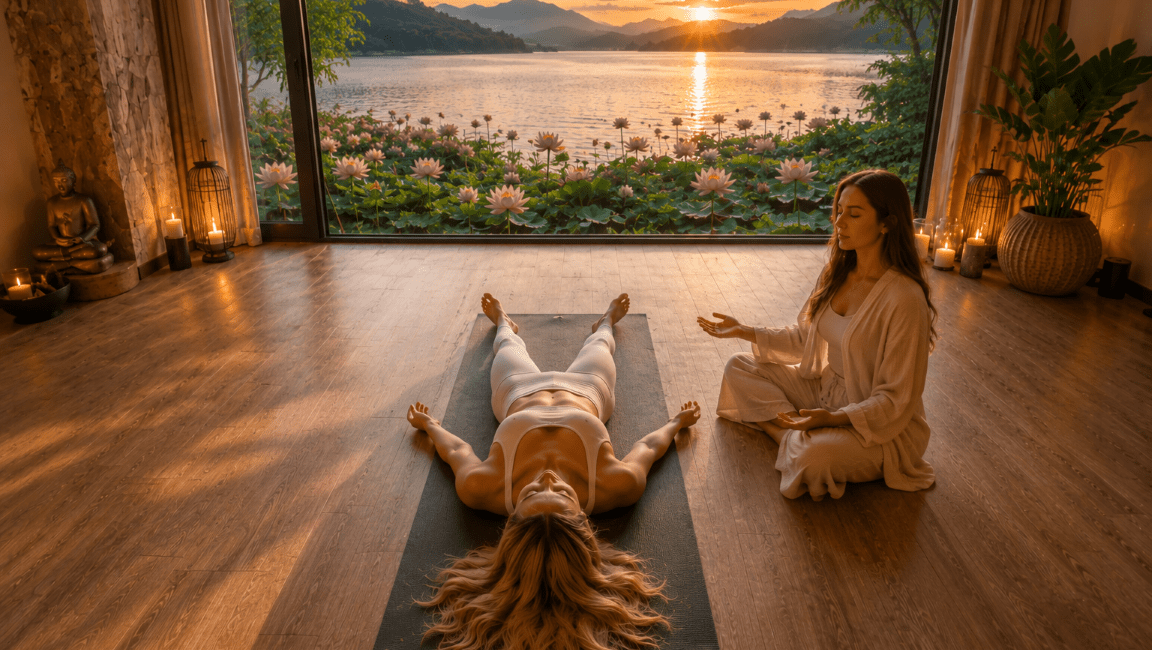
What is Osho Self-Hypnosis for Meditation?
According to Osho, self-hypnosis (often referred to as Hypnosis and Meditation) is seen as the ultimate way to quiet the mind and open the subconscious mind to meditation. Hypnosis is an excellent technique that you can use to free yourself from old, unconscious conditioning. Only when the mind (the thinking part of yourself) has been calmed by self-hypnosis does there be room for real meditation—a state of pure awareness and ‘witnessing’.
What is self-hypnosis?
According to Osho, self-hypnosis is essentially a tool to break free from your conditionings (de-hypnotize), after which real meditation can arise. Where self-hypnosis helps you program your subconscious mind for rest, meditation is the development of total, unconditional awareness.
Osho emphasized the interplay between these two processes:
- Self-hypnosis as cleansing: You can use self-hypnosis to break through the unconscious fear or stress and the ‘sleep’ in which we often go through life.
- The < strong >goal of meditation: Once the mind is still through self-hypnosis, you switch to meditation. Meditation is the pure ‘witnessing’ and observing without judgment.
The secret of hypnosis is that it takes you to the unconscious, and there you can plant the seed of anything,
after which it will grow and blossom.
The flowering will take place in the consciousness, but the roots remain in the unconscious.
As far as I am concerned, hypnosis will be one of the most important parts of the mystery school.
Such a simple method, which requires only a little trust and innocence, can bring about miraculous changes in your life – and not just in everyday things.
Slowly but surely it can become the way of your meditation.
You meditate, but you can't.
You are unable to observe; You get caught up in thoughts, you forget to observe.
You later recall, "I wanted to observe, but I'm thinking."
Hypnosis can help you; it can separate the observer and the thoughts.
For spiritual growth, I think there is nothing more important than hypnosis. OshoOsho
When is someone in a trance during a hypnosis?
During hypnosis, a person is in a trance when attention is strongly directed inwards and conscious thinking shifts to the background. You are not unconscious or asleep, but are in a state of deep focus and are more receptive to suggestions.
The state of trance can be recognized by specific physical and mental characteristics:- Physical changes: Breathing becomes slower and deeper, the heart rate drops, and the facial muscles relax completely. Sometimes the eyelids can vibrate very subtly or limbs feel heavy or very light.
- Mental focus and relaxation: The outside world fades. External stimuli come in less hard, so that you completely shut yourself off from the immediate environment and merge into your inner world.
- Changed sense of time: A session can feel much shorter or longer than in reality.
- Receptivity to suggestions: The subconscious becomes more easily accessible, which makes it possible to arrive at new insights or behavioral changes.
What is meditation?
There are many different, even opposing views on what meditation is.
01. Meditation is a state of being
You just ‘are’, just a pure experience, without interference from body or mind. It means that meditationis your natural essence, and not an act or activity that you perform.
It is a natural state, but we have forgotten how to get in touch with it. Everyone is usually dominated and directed by thoughts and feelings. It’s quite normal that we tend to think that we are those thoughts and feelings. But that is slightly different from the natural state of being!Do versus Being
- No activity: Meditation is not something you can do. As soon as you make an effort for something (such as concentrating or counting breaths), you are mentally active. This is an action of the ego.
- No result: It is not aimed at achieving a goal. It is the absence of goals, desires, and plans. You’re already there!
- Pure presence: It is the state that remains when all the doing, thinking and feeling has completely calmed down. You are simply here and now.
The resemblance to the ocean and the waves
Osho often compares the human mind to an ocean:
- The Waves (Doing): Your thoughts, emotions, worries, and daily tasks are the waves on the surface. This is the world of action and the mind.
- The Depth (Being): Deep below the surface, the ocean is always completely still and motionless. That depth is your state of being. Meditation is the sinking of the turbulent surface to that inner depth.
You’ve already forgotten
According to Osho, you are born with this state of being. Children live very close to it spiritually. Through conditioning, upbringing, and society’s focus on performance and thinking, we lose this state. Meditating is therefore not learning a new skill, but remembering who you are at your core when you stop running.
02. Is meditation a technique?
The word ‘meditation’ is also used when we actually mean a meditation technique. Tools for meditation and meditation techniques can be used to create an inner atmosphere so that we can no longer identify with the bodymind and just ‘be’. Initially, it makes sense to take the time to practice a structured meditation technique, until your meditative state – of relaxed awareness and centering – is no longer temporary, but has become as natural as, for example, your breathing.
Do you want to take a 7-day course?
Would you like to use this meditation? Click below to purchase the course and register for a 7-day training.
For dates look in the agenda.
What is the difference between hypnosis and meditation?
The main difference between self-hypnosis and meditation is in the goal and the approach. Meditation is all about acceptance and ‘being’ in the present moment. Self-hypnosis is goal-oriented; It is a technique to actively make changes in your behavior, thoughts or habits through targeted suggestions.
The main differences are listed:
Purpose and intention
- Meditation: The goal is to increase awareness, observe thoughts without judgment, and create inner peace. You accept what is.
- Self-hypnosis: The goal is to program the subconscious mind to achieve a specific result (e.g., reducing stress, quitting smoking, or relieving pain). You actively steer for change.
Focus and concentration
- Meditation: You focus your attention on a specific anchor (such as breathing) or observe all your thoughts and sensations very openly and broadly. It is attention-oriented meditation, not concentration meditation. The intention is to be as little in the mind as possible. Observing itself is central.
- Self-hypnosis: You use a deep focus and concentration on one specific idea, visualization or positive affirmation. You deliberately exclude distraction in order to allow the suggestion to penetrate the subconscious as powerfully as possible. Here the mind is active.
State of consciousness
- Meditation: You are basically fully conscious and alert, albeit in a calm and calm state. You are constantly aware of your surroundings and the present moment.
- Self-hypnosis: You put yourself in a light to deep state of trance. Your critical thinking skills are a little less active, making your mind more sensitive to positive suggestions and visualizations.
Additional Information & Tools
- Similarities: Both techniques require relaxation, a calm environment, and concentration, and they use similar breathing techniques
'Self-hypnosis should be at the service of meditation; That is its main use. But it can also promote health and longevity, it can be at the service of love and kindness and courage. Self-hypnosis can help you with anything you want. It can take away your fears of the unknown and your fear of death; It can help you to be alone, quiet, quiet. It can enable you to always, 24 hours a day, let an undercurrent of meditation pass through you.'
Osho
How is self-hypnosis a tool for meditation?
Self-hypnosis can be a powerful tool, but according to Osho’s philosophy, it works mainly as a preparatory step to calm the mind, not as the meditation itself. Self-hypnosis helps you to temporarily push aside the obstacles that block the ‘state of being’.
Here’s how self-hypnosis specifically helps to achieve that meditative state: 1. Lowering the mental noiseThe biggest barrier to meditation is an overactive mind full of stress and worrying. Self-hypnosis brings your brainwaves into a deep alpha state or theta state. This slows down the constant flow of thoughts, so that the underlying silence (the state of being) becomes felt more quickly.
2. Deprogramming the ‘Doer’ Idaily life, our inner critic or ‘the doer’ is always on. Through self-hypnosis you can temporarily switch off the critical filter of consciousness. You can suggest to yourself to let go of control or to be completely in the now. This makes your nervous system accept that it doesn’t have to perform anything at that moment.
3. Using Hyperfocus to Release Focus Zelfhypnosis uses extreme focus (for example on your breathing or a visualization) to shut out the rest of the world. As soon as your body and mind are completely relaxed by that focus, you can let go of the hypnosis technique. What remains in that deep relaxation is pure, meditative presence.
Osho’s important noteOsho himself has talked a lot about hypnosis (he often called it autohypnosis or samadhi with a method). He warned of one key difference: Self-hypnosis is still a technique with a purpose (you use your mind to calm your mind). It is a deep, conscious sleep or conditioning. Meditation is total de-conditioning and wakefulness.
The conclusion:Use self-hypnosis as a ‘scaffolding’ to build a calm inner house. As soon as the house is up and the peace is there, you let go of the self-hypnosis and switch to pure witnessing.

Take the 7-day course
In 7 one-hour sessions spread over 7 days, you will learn to relax yourself with self-hypnosis. This teaches you a skill that you can always use, in all kinds of areas. This way you can let the tensions you build up in your work or private life flow away with it. You can improve your health, but also your love relationship or friendships. It can help you be more creative and live more joyfully. Self-hypnosis is also a powerful tool for meditation, allowing you to go deeper into stillness and awareness.
- Have you ever made up your mind to meditate more? To then, when you look back a few days later, notice that nothing happened?
- Maybe you even had an excuse not to meditate every time the idea of meditation came up?
- Or, if you did force yourself to sit still, did you feel angry and rebellious when you saw your thoughts going in all directions?
- And therefore, another decision! Maybe this time it will be included in your agenda… Can decisions help you?
Osho’s view on this is that decisions do not provide a solution – that a decision only means that the ego enters into a battle with the subconscious mind – a battle that the ego is sure to lose.
"What is a decision? A decision is a fight. A decision is the ego. The subconscious never hears what the conscious decides, and the conscious cannot control the subconscious – the subconscious is so huge."
Osho
Self-hypnosis is a way to bypass the ego and our analytical thinking and to work directly with the unconscious, where you can really find the power to initiate change. In this 7 days of OSHO Self-Hypnosis for Meditation you will learn how to go into a hypnotic trance very easily and how to use post-hypnotic suggestions to create a change in your life. Learn to use self-hypnosis to bypass the mind and to easily enter a state where witnessing is possible; where your meditation becomes deeper and you become part of the ‘flow’ of your daily life.